Introduction:
Modern construction and interior fit-out projects require partition systems that combine installation efficiency, structural reliability, design flexibility, and long-term performance. However, the quality of a completed drywall partition depends on much more than the gypsum boards visible on the surface. Behind every straight, stable, and professionally finished wall is a carefully coordinated framework of studs, tracks, corner beads, fasteners, and supporting profiles. As a dependable Dry Wall Partition System Manufacturer in UAE, Allied Ispat LLC understands how selecting compatible and accurately manufactured components can help contractors improve installation efficiency, maintain better alignment, and achieve consistent project results.
Drywall partition systems are widely used across residential developments, commercial buildings, hospitality projects, healthcare facilities, educational institutions, and other modern infrastructure projects. Their lightweight construction and installation flexibility make them suitable for creating functional interior spaces without depending entirely on conventional masonry walls. However, these advantages can only be fully achieved when the underlying metal framing components are selected according to the project’s dimensional, structural, installation, and environmental requirements.
Different project stakeholders naturally have different priorities. Architects and consultants focus on design requirements and specification compliance. Contractors are concerned with installation speed, material handling, and site productivity. Developers look for dependable performance and controlled project costs, while procurement professionals require consistent product quality, accurate quantities, and reliable supply.
Selecting drywall components individually without understanding how they function as a complete system can result in poor alignment, excessive cutting, material wastage, unstable framing, installation difficulties, and unnecessary rework. This guide explores the essential drywall partition components, their functions, important material and procurement considerations, common mistakes to avoid, and why choosing an experienced manufacturer can contribute to smoother project execution and reliable long-term performance.
Why Understanding Dry Wall Partition System Components Matters Before Project Planning
A drywall partition should be approached as a complete construction system rather than a collection of unrelated materials. The metal framework, board covering, fasteners and finishing elements must work together to create a partition that is straight, stable and suitable for its intended use.
Every component performs a connected function
Floor and ceiling tracks establish the partition line. Vertical studs fit within those tracks and create the main supporting framework. Gypsum boards are then fixed to the studs, while corner beads protect exposed edges and help create clean finishes.
When one element is incorrectly sized or poorly formed, it can affect the components installed after it. A track that does not properly accommodate the selected stud may require force, cutting or on-site modification. A stud with inconsistent dimensions may cause difficulties when boards are aligned and fixed.
This is why professional buyers should consider the complete assembly before approving a purchase order.
Poor component selection affects wall performance
Low-quality or incompatible metal framing components can result in uneven surfaces, movement, weak board fixing points or inconsistent wall thickness. These issues may not always be visible during initial installation, but they can appear later as joint cracking, loose edges, damaged corners or maintenance concerns.
For projects involving repeated room layouts, long corridors or large commercial floors, even a small dimensional inconsistency can be repeated across hundreds of metres of partition work.
Compatibility directly influences installation efficiency
Compatible drywall studs and tracks fit together with fewer site adjustments. Installers can measure, position and secure the framework more efficiently because the components respond consistently.
This improves workflow in projects where multiple teams must coordinate partitioning with electrical, plumbing, HVAC and finishing activities. When framing installation falls behind schedule, several follow-on trades may also be delayed.
Early planning reduces material loss and rework
Before ordering, project teams should review wall heights, partition lengths, stud spacing, board layers, service openings and project phases. This helps determine the correct component type and quantity.
Accurate planning also reduces emergency purchases. Last-minute sourcing can introduce products from different manufacturers or batches, increasing the risk of dimensional incompatibility.
The entire system should be evaluated
Architects, contractors, consultants and purchase teams should avoid evaluating studs, tracks or corner beads only as individual price items. They should assess how each product supports the entire partition assembly.
Working with an experienced Drywall Partition Components Manufacturer in UAE makes this evaluation easier because buyers can discuss the required framework as a coordinated product package rather than sourcing every section independently.
What Are the Essential Components of a Modern Dry Wall Partition System?
A standard drywall partition system contains several components, each performing a different structural, installation or finishing role. The exact arrangement may vary according to the wall design, application and approved project specification.
Drywall studs form the vertical framework
Studs are upright metal sections positioned between the floor and ceiling tracks. They support the gypsum boards and help maintain the height, alignment and rigidity of the partition.
The width, thickness, length and spacing of the studs should be selected according to the partition design. Taller walls, multiple board layers, service integration or demanding applications may require a different framing arrangement from a basic internal partition.
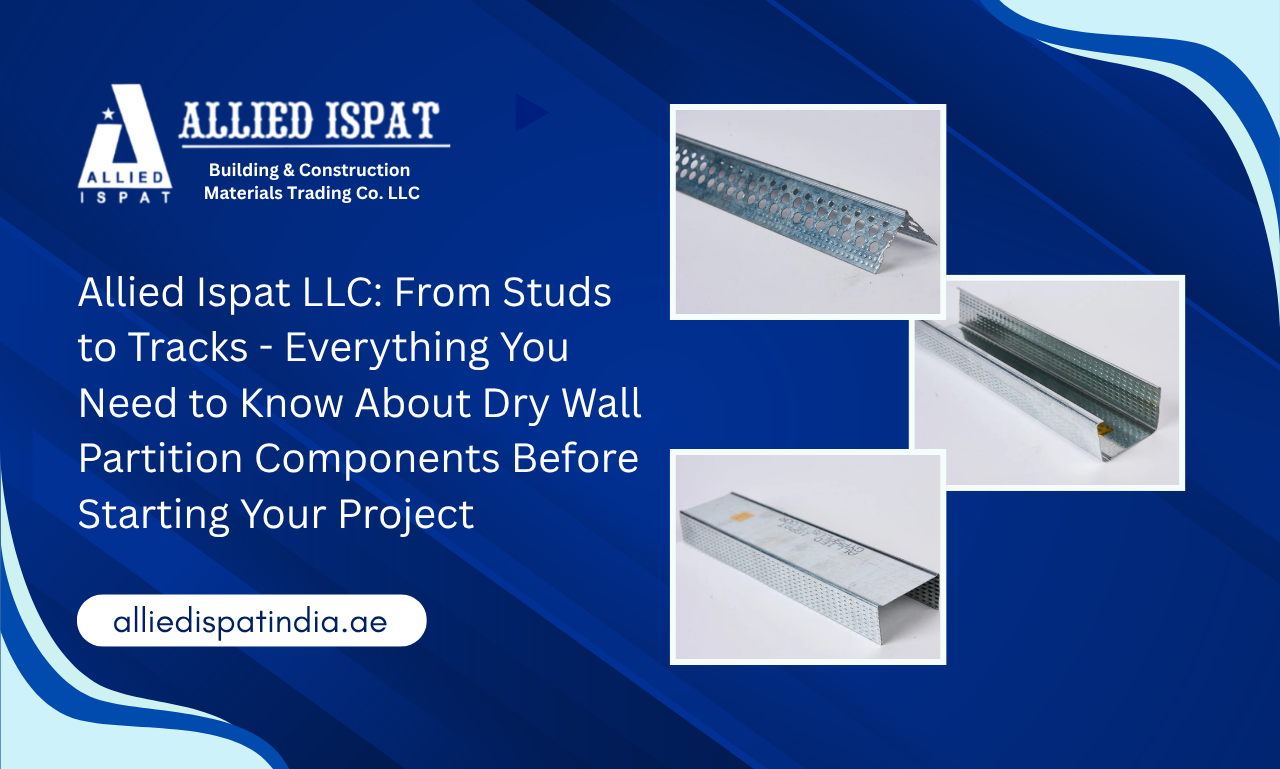
At Allied Ispat LLC, stud drywall partition components form part of the company’s system offering for modern interior construction. The company describes these studs as vertical supports used for partition coverings such as gypsum boards.
Floor and ceiling tracks define the wall line
Tracks are horizontal profiles installed at the bottom and top of the partition. The lower track establishes the floor line, while the upper track guides and contains the studs at ceiling or slab level.
Accurate track installation is essential. If the base track is not straight, the resulting partition may gradually move away from the intended layout. Similarly, an incorrectly aligned head track can cause studs to lean or twist.
Stud tracks maintain alignment and stability
Stud tracks provide the supporting framework into which the vertical members are placed. They help create a continuous and organised framing line across the partition.
The stud and track dimensions must be compatible. An overly tight fit can slow installation, while an excessively loose fit may make positioning and alignment more difficult.
Corner beads protect vulnerable edges
External drywall corners are exposed to frequent impact during construction and later use. A corner bead reinforces these edges and helps the finishing team produce a straight, clean corner.
Allied Ispat LLC offers perforated corner bead components designed to reinforce and protect drywall corners while supporting a seamless finish.
Corner beads are especially relevant in corridors, offices, retail environments and other spaces where wall edges may be exposed to regular movement of people, furniture or equipment.
Supporting accessories complete the installation
A full partition system may also require fasteners, connectors, bracing, backing sections, jointing accessories and components around doors or service openings. These items should be selected according to the approved installation details.
Before procurement, buyers should confirm:
- Profile width and section shape
- Material thickness
- Required component lengths
- Compatibility between studs and tracks
- Quantity and spacing requirements
- Board type and number of layers
- Project-specific fixing and reinforcement details
A professional Drywall Partition Components Manufacturer in UAE should be able to clearly identify the supplied profile type and help commercial buyers align product selection with their approved requirements.
How Drywall Studs and Tracks Create a Strong Partition Framework
Studs and tracks form the main skeleton of a lightweight partition. Their interaction affects wall straightness, board support and the efficiency of the installation process.
Studs distribute and support loads
Drywall partitions are generally non-load-bearing building elements, but the framing must still support the boards, finishes and permitted attachments specified for the wall system.
Studs provide repeated vertical fixing points. They transfer the weight of the board covering through the framework and help control movement along the wall surface.
Stud selection should therefore reflect the intended wall height, board arrangement and service requirements rather than being based only on what is immediately available in stock.
Tracks guide the complete framework
Tracks create the upper and lower boundaries of the partition. Once aligned and secured, they guide the position of every stud.
A small error in track placement can become a major issue over a long wall. Contractors should verify the layout, line and level before installing the complete framework.
The track must also retain its shape during handling and installation. Distorted profiles can affect stud positioning and require time-consuming correction.
Stud spacing affects rigidity and board fixing
Stud centres should follow the approved wall design and board installation requirements. Inconsistent spacing can leave board edges unsupported, make screw fixing difficult or create unnecessary board cutting.
Regular spacing also helps other trades plan service routes and opening positions. This is particularly useful in offices, hotels and hospitals where partitions may contain electrical conduits, communication cables, plumbing lines or additional internal support.
Dimensional accuracy simplifies repeated installation
In large projects, framing components may be installed across multiple floors, units or phases. Accurate profile dimensions help installation teams repeat the same process without continually adjusting their methods.
A well-formed stud fits predictably within its matching track. The installer spends less time forcing, reshaping or sorting components. This contributes to better site productivity and more consistent finished work.
Better framing supports faster project progress
High-quality framing does not remove the need for skilled installation, but it reduces avoidable obstacles. Straight sections are easier to measure, cut and align. Consistent edges create dependable board fixing surfaces.
As a result, teams can move from layout to framing and board installation with fewer interruptions. This is one of the practical reasons contractors prefer sourcing coordinated metal framing solutions from a reliable Dry Wall Partition System Manufacturer in UAE.
Material Quality, Thickness and Corrosion Resistance in Drywall Partition Components
The visible finish of a drywall partition may hide the framework, but the performance of that framework remains important throughout the life of the interior.
Raw material quality influences consistency
The behaviour of a formed metal profile depends partly on the quality of the raw material used to manufacture it. Consistent material supports predictable forming, profile shape and handling performance.
Allied Ispat LLC states that its drywall partition components are produced using galvanized steel to support corrosion resistance and lasting durability. The company also positions these systems for the heat and humidity associated with UAE environments.
For B2B procurement, material quality should be considered together with profile geometry and manufacturing consistency.
Thickness must suit the application
Metal thickness affects profile rigidity, weight, ease of handling and resistance to deformation. However, a thicker product is not automatically the correct product for every project.
The suitable thickness depends on factors such as:
- Partition height
- Stud spacing
- Number and type of board layers
- Door and service openings
- Required rigidity
- Project specifications
- Consultant-approved system details
Purchase teams should avoid substituting one thickness for another without technical approval. Even when products appear visually similar, their performance and installation behaviour may differ.
Corrosion resistance matters in demanding conditions
Drywall framing is generally concealed, which means early signs of surface deterioration may not be noticed after the wall is closed. Galvanized metal components offer additional protection compared with untreated steel.
This is particularly relevant in humid buildings, coastal areas, spaces near wet services, conditioned interiors and projects where materials may be stored on site before installation.
Corrosion resistance does not replace proper storage or moisture control. Components should still be protected from standing water, contamination and poor site handling.
Manufacturing tolerances affect bulk installation
For a small partition, installers may be able to correct a few inconsistent pieces. On a large project, repeated variation can create serious productivity problems.
Professional manufacturers control profile dimensions so that sections from the same product range behave consistently. This allows contractors to use standard cutting, spacing and fixing procedures across the project.
Buyers evaluating a Drywall Partition Components Manufacturer in UAE should therefore consider repeatability, not just the appearance of one sample.
What buyers should inspect before a bulk order
Procurement professionals can improve purchase decisions by requesting and reviewing:
- Product descriptions and profile dimensions
- Material and coating information
- Available lengths and packaging
- Samples from the proposed product range
- Compatibility between stud and track profiles
- Surface condition and edge formation
- Supply capacity for the required project phases
- Procedures for repeat and replacement orders
A technically suitable product must also be commercially available in the quantities and timeframes required by the project.
How to Select the Right Dry Wall Partition Components for Different Projects
Not every partition performs the same function. A residential room divider, hospital corridor wall and industrial office partition may require different component arrangements.
Residential developments and housing projects
In apartments, villas and residential towers, drywall partitions are commonly used for bedrooms, corridors, utility spaces, wardrobes and internal layouts.
Selection should consider wall height, room function, service routing and expected fixtures. Areas supporting wall-mounted cabinets, televisions or sanitary accessories may need additional backing or reinforcement according to the design.
For multi-unit developments, consistent component dimensions are especially valuable because the same room layouts are repeated many times.
Offices and commercial interiors
Commercial spaces often require adaptable layouts, clean finishes and efficient installation. Drywall systems allow offices, meeting rooms, retail areas and administrative spaces to be divided with less structural weight than conventional masonry.
However, commercial partitions may also need to accommodate electrical points, data cabling, access control equipment, glass interfaces and door frames. The framing plan should account for these elements before the walls are closed.
A capable Drywall Partition Components Manufacturer in UAE can support suppliers and contractors by providing coordinated studs, tracks and corner protection profiles for repeated commercial applications.
Hotels, hospitals, schools and public facilities
Institutional and hospitality projects usually involve high levels of coordination. Partitions may need to satisfy project-specific requirements relating to acoustics, fire performance, hygiene, impact resistance or service access.
The metal profile alone does not determine the total system performance. Boards, insulation, jointing materials, sealants, fixings and installation details all contribute to the completed assembly.
Buyers should therefore follow approved system drawings and avoid assuming that one standard framing arrangement is suitable for every room type.
Industrial and high-traffic applications
Partitions in warehouses, production facilities, loading environments or high-traffic back-of-house areas may face greater impact and operational stress.
These applications may require more robust framing, closer stud spacing, additional board layers or reinforcement around openings. The exact design should be established by the project consultant or system designer.
Corner protection is also important where trolleys, equipment or stored materials may contact wall edges.
Project specifications must guide selection
Before releasing an order, the project team should confirm:
- Finished wall height and thickness
- Stud and track dimensions
- Framing spacing
- Board type and layers
- Acoustic or fire-rated assembly requirements
- Door, glazing and access openings
- Internal services
- Expected wall-mounted loads
- Moisture exposure
- Approved drawings and material submittals
Price comparisons are meaningful only when the products being compared satisfy the same technical requirements.
Common Dry Wall Partition System Procurement and Installation Mistakes to Avoid
Many drywall problems begin before installation. Incomplete specifications, unsuitable substitutions and poor quantity planning can create difficulties that site teams are later expected to solve.
Selecting only on the lowest price
The lowest unit price may appear attractive during tendering, but it can become expensive if the components are inconsistent, easily damaged or difficult to install.
Additional labour, sorting, cutting, replacement material and delayed progress can outweigh a small initial saving. Commercial evaluation should include total installed value, not only purchase price.
Mixing incompatible profiles
Studs and tracks from unrelated product ranges may not fit correctly. Even small dimensional differences can create loose or tight connections.
When multiple suppliers are used, the contractor should verify compatibility before bulk installation. Ideally, coordinated components should be sourced as part of one approved framework package.
Ignoring dimensions and tolerances
Product names alone are not enough. Buyers should confirm section width, flange dimensions, thickness and length.
A generic description such as “drywall stud” can cover several different products. Purchase orders should contain enough detail to prevent accidental substitution.
Underestimating quantities and delivery stages
Ordering too little material can interrupt work. Ordering the entire requirement too early can create storage, handling and damage concerns.
A more effective approach is to calculate total quantities, include an approved allowance and coordinate deliveries with the construction programme. Repeated room layouts should be checked against actual site conditions before final quantities are released.
Depending on inconsistent supply
A supplier may provide an acceptable first batch but struggle with repeat orders. This creates a risk when a project extends across several months or phases.
Working with an established Drywall Partition Components Manufacturer in UAE helps procurement teams maintain continuity in profile dimensions, finish and product availability.
Contractors should also establish clear communication regarding required quantities, delivery locations, packaging and order schedules before work begins.
Why B2B Buyers Choose an Experienced Dry Wall Partition System Manufacturer in UAE
Manufacturer selection is a strategic procurement decision. The right supplier contributes not only products but also consistency, communication and dependable order fulfilment.
Consistent manufacturing supports predictable installation
Accurately formed metal profiles are easier to handle and install. When each batch follows the same product dimensions, site teams can continue using the same methods across different floors and phases.
This consistency supports quality control, reduces uncertainty and simplifies repeat procurement.
Project understanding improves product selection
An experienced supplier understands that a contractor may need different component combinations for walls, corners, ceilings and access requirements.
Instead of treating every enquiry as a basic product sale, a project-focused supplier asks about profile types, quantities, intended applications and delivery expectations.
Allied Ispat LLC supplies drywall partition components including studs, stud tracks and perforated corner beads as part of its UAE product range.
Reliable supply matters at every project scale
Small office renovations and major developments have different purchasing patterns. A fit-out contractor may need quick, phased deliveries, while a distributor may require planned bulk quantities for stock and resale.
An experienced Dry Wall Partition System Manufacturer in UAE should be capable of supporting different B2B order requirements while maintaining product consistency.
Repeat orders require continuity
Construction projects often change. Additional rooms may be added, layouts may be revised or replacement quantities may be required.
Using a dependable supplier improves the chance that later batches will match the earlier products. This is particularly important when the framing has already been approved and installation is underway.
Communication strengthens procurement relationships
Responsive communication helps buyers clarify availability, specifications, quantities and delivery planning before problems reach the site.
At Allied Ispat LLC, we understand that B2B customers are not simply buying isolated steel sections. They are managing deadlines, labour, approvals and coordination with multiple project stakeholders. Our approach as a Drywall Partition Components Manufacturer in UAE is therefore centred on dependable product supply and practical commercial support.
Why Allied Ispat LLC Is a Reliable Partner for Drywall Partition and POP Frame Requirements
Allied Ispat LLC serves the requirements of modern interior construction through products designed for drywall partitions, furring ceiling systems and ceiling access applications. The company’s current UAE range includes drywall studs, stud tracks and corner bead components.
Practical understanding of construction requirements
We recognise that every project has different technical and commercial priorities. Some buyers need material for a single fit-out package, while others manage repeated procurement for developments, distribution networks or international supply.
Our team approaches these requirements with an understanding of contractor workflows, material coordination and the importance of timely product availability.
Focus on product consistency
A metal framing component should arrive in a condition that allows it to be handled, measured and installed efficiently. Profile shape, dimensions and surface finish all influence site performance.
As a Dry Wall Partition System Manufacturer in UAE, Allied Ispat LLC focuses on supplying galvanized steel partition components intended to support durability, corrosion resistance and efficient installation in UAE construction environments.
Solutions for diverse B2B customers
Our drywall and metal framing solutions are relevant to:
- Main contractors and subcontractors
- Interior fit-out companies
- Drywall and false ceiling contractors
- Architects and consultants
- Developers and infrastructure companies
- Procurement and purchase departments
- Building material distributors
- Dealers and wholesalers
- Importers, exporters and international buyers
By working with different B2B customer groups, we understand the need for clear product communication and consistent commercial service.
Long-term supply relationships
A dependable supplier relationship becomes more valuable as projects and businesses grow. Buyers need confidence that they can discuss new quantities, repeat products and upcoming requirements with a familiar team.
Allied Ispat LLC aims to support not only immediate purchases but also long-term procurement partnerships built around responsive service and reliable supply.
Drywall partition and POP frame support from one industry partner
Interior projects frequently involve both wall partitioning and false ceiling construction. Coordinating these requirements through an experienced supplier can simplify communication and sourcing.
For companies searching for a reliable Drywall Partition Components Manufacturer in UAE and an established POP Frames Manufacturer in UAE, Allied Ispat LLC offers a relevant range of metal framing solutions for modern construction and interior fit-out applications.
We encourage customers to share their component requirements, profile details, quantities and delivery expectations so our team can better understand the scope of the enquiry.
Frequently Asked Questions
1. What are the main components of a dry wall partition system?
A dry wall partition system generally includes metal studs, floor and ceiling tracks, corner beads, gypsum boards, fasteners, and supporting accessories. Allied Ispat LLC provides quality metal framing components for modern construction and interior fit-out requirements.
2. How do I choose the right drywall partition components for my project?
The right components depend on wall height, application, profile dimensions, board layers, and project specifications. Allied Ispat LLC helps B2B buyers source suitable drywall partition components based on their construction and procurement requirements.
3. What is the difference between drywall studs and tracks?
Drywall studs are vertical metal profiles that form the main supporting framework, while tracks are horizontal sections installed at the floor and ceiling. Allied Ispat LLC supplies compatible metal framing components designed for efficient drywall partition installation.
4. Which material is best for drywall partition framing?
Galvanized steel is commonly used for drywall partition framing because of its durability, strength, dimensional consistency, and corrosion resistance. Allied Ispat LLC provides galvanized steel components suitable for modern interior construction applications.
5. Why is galvanized steel used in drywall partition systems?
Galvanized steel provides additional protection against corrosion while offering the rigidity required for reliable metal framing. Allied Ispat LLC uses quality-focused manufacturing practices to provide dependable drywall partition components for B2B projects.
6. Where can I find a reliable Dry Wall Partition System Manufacturer in UAE?
When selecting a Dry Wall Partition System Manufacturer in UAE, consider product quality, profile consistency, supply capability, and B2B service. Allied Ispat LLC supplies drywall partition components for contractors, developers, consultants, distributors, and international buyers.
7. How can quality drywall components improve installation efficiency?
Accurately formed studs and tracks fit together more consistently, helping reduce unnecessary adjustments, material handling issues, and installation delays. Allied Ispat LLC provides metal framing components designed to support efficient project execution.
8. What should I check before ordering drywall partition components in bulk?
Before placing a bulk order, verify profile dimensions, material thickness, required lengths, quantities, component compatibility, and delivery schedules. Allied Ispat LLC supports B2B procurement requirements for construction, fit-out, distribution, and project-based applications.
9. Does Allied Ispat LLC supply drywall partition components for large projects?
Yes. Allied Ispat LLC serves contractors, developers, fit-out companies, procurement teams, distributors, dealers, wholesalers, and international buyers with drywall partition solutions for diverse B2B project requirements.
10. Why should I choose Allied Ispat LLC for drywall partition and POP frame requirements?
Allied Ispat LLC focuses on product consistency, galvanized steel components, responsive B2B service, and dependable supply support. Businesses seeking a Dry Wall Partition System Manufacturer in UAE or POP Frames Manufacturer in UAE can contact the company for product and bulk order enquiries.
Conclusion: Build Better Partitions by Making Better Procurement Decisions
The performance of a drywall partition begins long before the gypsum boards are fixed. It starts with clear specifications, compatible components, suitable material selection and an organised procurement plan.
Studs, tracks, corner beads and supporting profiles must work together as one framework. When buyers focus only on individual unit prices, they may overlook dimensional consistency, installation efficiency, corrosion resistance and repeat supply. These factors directly affect site productivity and the quality of the completed wall.
For contractors and consultants, accurate framing supports easier alignment and board installation. For developers, it contributes to a more controlled construction process. For procurement teams and distributors, dependable manufacturing helps maintain continuity across bulk orders, project phases and future requirements.
Allied Ispat LLC combines practical industry understanding with a focused range of galvanized steel framing products for modern interior applications. As a reliable Dry Wall Partition System Manufacturer in UAE, we support B2B customers seeking dependable drywall studs, tracks and corner protection profiles. Our experience as a POP Frames Manufacturer in UAE also allows us to serve businesses managing both partition and false ceiling requirements.
Contractors, architects, developers, project consultants, purchase teams, dealers, wholesalers and international buyers are invited to contact Allied Ispat LLC to discuss product information, bulk quantities, project-specific requirements and long-term supply opportunities.
Contact Allied Ispat UAE
Address: Dubai, UAE: P.O Box 29432 , Dubai, UAE
Contact: +971552989815 | +971553278988
Email: info@alliedispat.ae | sales@alliedispat.ae
Direction: https://maps.app.goo.gl/ed189X6gEZZd5STv7
Website: https://alliedispat.ae/