Introduction:
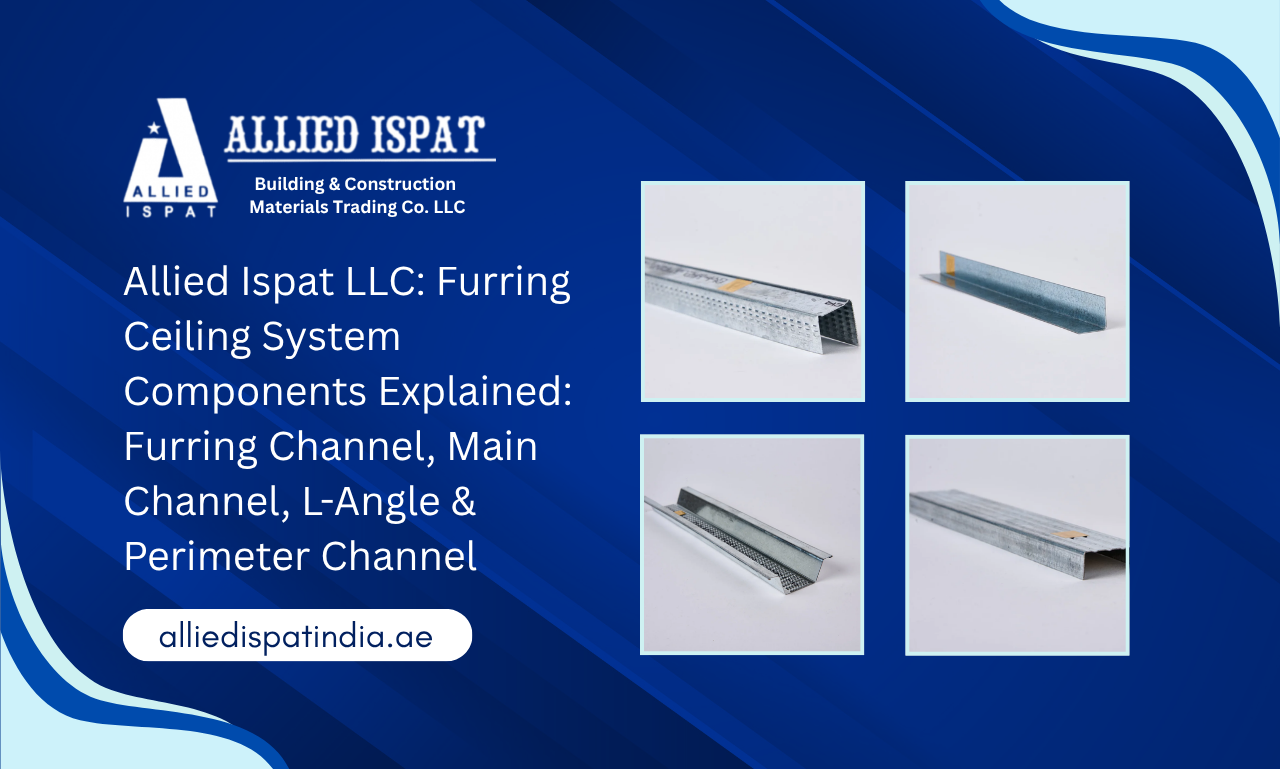
A finished false ceiling may appear simple from below, but its performance depends heavily on the concealed steel framework installed above it. Furring channels, main channels, L-angles and perimeter channels each perform a specific function in creating an accurately aligned framework for ceiling board installation. For contractors, consultants, fit-out companies and procurement teams, understanding how these components work together is essential when evaluating material quality, installation efficiency and consistency across large project quantities.
Allied Ispat LLC, a Furring Ceiling System Manufacturer in UAE, serves the requirements of construction companies, interior contractors, distributors and project buyers seeking dependable metal ceiling profiles for UAE and international projects. Rather than viewing individual profiles as isolated products, we approach furring ceiling systems as coordinated assemblies in which profile geometry, material consistency, compatibility and manufacturing repeatability all influence the quality of project execution.
For companies searching for a Furring Channel Manufacturer in Dubai, price alone should not determine the procurement decision. A channel must arrive with the required profile consistency, integrate correctly with the specified ceiling framework and remain dependable across initial and repeat quantities. This becomes particularly important for commercial developments, residential projects, offices, hospitality spaces, retail fit-outs and other applications where large ceiling areas require systematic installation.
Understanding the Steel Framework Behind a Well-Executed Furring Ceiling System
What Is a Furring Ceiling System?
A furring ceiling system is a concealed metal framework used to establish the supporting arrangement required for a suspended or false ceiling. Depending on the specified ceiling configuration, the framework combines profiles such as main channels, furring channels, L-angles, perimeter channels and associated suspension components.
Each profile serves a defined purpose. The system is therefore better understood as an interconnected framework rather than a collection of separate metal sections. For project teams, this distinction matters because the performance and installation of one profile can be influenced by how effectively it coordinates with the profiles around it.
Why the Concealed Framework Matters
Once a ceiling is completed, attention naturally shifts to its visible surface. The steel ceiling framework, however, has already played an important role in establishing the level, alignment and fixing arrangement needed to achieve that finish.
In commercial ceiling systems, repeated alignment across substantial areas requires an organized supporting framework. Main channels contribute to the primary support arrangement, while ceiling furring channels provide the secondary framework associated with board installation. Boundary profiles then help coordinate the ceiling around walls and edges.
This is why experienced contractors evaluate the framework before considering the decorative result. A ceiling cannot be separated from the quality and accuracy of the structure behind it.
Different Profiles Perform Different Functions
Although furring channels, main channels, L-angles and perimeter channels may all be manufactured from metal, their functions should not be confused.
The main channel forms part of the primary supporting framework. The furring channel provides the secondary framing associated with supporting the ceiling board. L-angles fulfil their specified supporting role, while perimeter channels help establish the framework at wall boundaries.
Understanding these distinctions enables architects, estimators, contractors and purchasing teams to specify materials more accurately and avoid unnecessary substitutions during procurement.
Why B2B Buyers Should Assess the Complete Ceiling System
Large projects often involve bulk procurement, phased deliveries and repeat material requirements. Selecting one ceiling profile without checking its relationship with the overall system can create unnecessary coordination issues later.
A professional Furring Ceiling System Manufacturer in UAE should therefore understand the complete ceiling framing requirement. Profile compatibility, quantities, specifications, project schedules and repeat supply all become important considerations when ceiling materials are being sourced for commercial construction rather than small individual installations.
Furring Channel Manufacturer in Dubai: Understanding the Profile Behind Ceiling Board Support
What Is a Furring Channel?
A furring channel is a secondary metal framing profile used within a false ceiling framework to create an organized surface for the installation of gypsum board or other specified ceiling boards.
Its function may appear straightforward, but it is repeated throughout the ceiling area. That repetition makes profile accuracy particularly important. When hundreds or thousands of lengths are being handled across a project, consistency can have a direct influence on how smoothly installers establish the ceiling plane.
Where Does the Furring Channel Sit in the Framework?
Furring channels are generally coordinated with the primary main channel arrangement. Together, these profiles form different levels of the supporting framework required before the finished ceiling board is installed.
For buyers comparing a Furring Channel Manufacturer in Dubai, this relationship is important. Procurement should not focus only on the shape of an individual furring channel. The profile should be evaluated according to the specified ceiling system, application, material requirements and compatibility with the rest of the framework.
Why Dimensional Consistency Matters
Installation work is repetitive by nature. Site teams expect one section to behave consistently with the next. Unnecessary variations in geometry or straightness may require additional checking and adjustment, particularly across large ceiling areas.
Manufacturing repeatability therefore has commercial value. Consistent GI furring channels help contractors work with predictable materials and enable procurement teams to approach repeat orders with greater confidence.
For distributors, consistency is equally important because customers expect subsequent supplies to remain aligned with the specifications of previous orders.
Price Should Be Evaluated Alongside Project Value
Procurement decisions inevitably involve price, but the lowest unit rate does not automatically represent the lowest overall project cost.
Material consistency, packaging, compatibility, availability, replacement requirements, installation efficiency and supply continuity should also be considered. An experienced Furring Channel Manufacturer in Dubai should be able to understand these B2B priorities rather than treating every enquiry as a simple commodity purchase.
Main Channel: Creating the Primary Support Framework for False Ceilings
What Is the Purpose of a Main Channel?
The main channel is an important part of the primary supporting arrangement within a furring ceiling system. It provides the framework with which secondary profiles such as furring channels are coordinated.
This distinction between primary and secondary framing helps project teams understand why main channels and furring channels should not be considered interchangeable. Each profile contributes differently to the ceiling framework.
How Main Channels Coordinate with Furring Channels
The main channel establishes the principal supporting layout, while furring channels create the secondary board-supporting arrangement. When correctly specified and installed, the two form an organized ceiling framing system.
This relationship is particularly important across large ceiling areas. A systematic framework gives installation teams clear reference points for positioning profiles and preparing the ceiling for subsequent board fixing.
Why Straightness and Profile Geometry Matter
Straightness is more than a visual manufacturing characteristic. Ceiling profiles are installed repeatedly across the same plane, meaning irregularities can become more noticeable when several sections are brought together.
Accurate profile geometry also assists compatibility. A main channel manufactured consistently according to the required profile makes it easier for site teams to work with the corresponding secondary framing.
From a procurement perspective, this is why manufacturing quality should be considered alongside the basic material description.
Consistent Components Support Better Project Coordination
Ceiling construction involves more than installers. Consultants, procurement managers, project engineers, warehouse teams and site supervisors may all interact with the same material package.
Using consistently manufactured false ceiling channels helps create a more predictable supply and installation process. This becomes increasingly valuable when the same ceiling system is repeated across floors, rooms or multiple project phases.
L-Angle & Perimeter Channel: Building Accurate Ceiling Boundaries
Understanding the Function of an L-Angle
The L-Angle is an angle-shaped metal profile used as part of the specified ceiling supporting arrangement. Its geometry makes it suitable for locations where an angle section is required within the designed ceiling framework.
Its exact positioning should always follow approved project drawings and installation specifications. For B2B procurement teams, correct identification of the profile is important because visually similar ceiling components may have different intended functions.
What Is a Ceiling Perimeter Channel?
A perimeter channel is used around the boundaries of the false ceiling framework, particularly where the ceiling system interfaces with surrounding walls.
The perimeter is an important reference point during installation. Correctly specified ceiling perimeter channels help establish an organized boundary around which the internal framing can be coordinated.
L-Angle vs Perimeter Channel: Understanding the Difference
L-angles and perimeter channels should not automatically be treated as alternative names for the same component.
An L-Angle has an angle-shaped profile and fulfils its specified supporting role, while a perimeter channel is specifically associated with the ceiling boundary. The project design, approved ceiling system and installation detail should determine which component is required at each location.
Clear distinction at the enquiry and purchase-order stage helps reduce ambiguity when quantities are manufactured, packed, delivered and distributed on site.
Accurate Edges Contribute to an Accurate Ceiling Layout
Large central ceiling areas receive much of the attention during installation, but boundaries require equal consideration. Wall junctions and corners establish reference points for the overall layout.
Accurately manufactured perimeter profiles give installers a consistent component with which to establish those boundaries. This is another reason buyers evaluating a Furring Channel Manufacturer in Dubai should consider the supplier’s broader capability across the complete furring ceiling system.
How Furring Channels, Main Channels, L-Angles & Perimeter Channels Work as One System
Primary Support Begins with the Main Framework
The ceiling arrangement starts with the structural and suspension conditions established by the approved project design. The main channels then form an important part of the primary supporting framework.
Correct positioning at this stage provides the basis for coordinating the secondary ceiling profiles that follow.
Furring Channels Establish the Secondary Framework
Furring channels are positioned in coordination with the main framework to create the supporting surface associated with ceiling board installation.
In simple terms, the main channel and furring channel perform different but connected jobs: one contributes to the primary framework, while the other establishes the secondary framing used for the finished ceiling arrangement.
L-Angles and Perimeter Channels Coordinate the Boundaries
As the internal framework develops, ceiling edges also need to be established according to the approved system.
Perimeter channels help define the framework at wall interfaces, while L-angles perform their specified supporting function. Together with the central framing, these components help transform individual metal profiles into a coordinated ceiling system.
From Structure to Finished Ceiling: The Complete Sequence
For quick understanding, a typical system relationship can be expressed as:
Structural/support point → suspension arrangement → main channel → furring channel → L-Angle/perimeter coordination → ceiling board → finished surface
This sequence is useful for understanding the role of each component, although actual fixing arrangements, spacing and installation details must always follow the approved project specification.
For a Furring Ceiling System Manufacturer in UAE, understanding this complete relationship is important because professional buyers often require more than a single profile. They need a coordinated material package that fits their project requirements.
Why Manufacturing Precision Matters in Furring Ceiling System Components
Consistency Becomes More Important as Quantities Increase
A small variation may appear insignificant when examining one profile. Across hundreds or thousands of sections, however, repeated differences can create practical installation challenges.
Commercial projects therefore place considerable value on consistency. Contractors want materials that behave predictably, while procurement managers want repeat orders to correspond with approved requirements.
Profile Geometry Influences Installation Compatibility
Every ceiling channel has a defined cross-sectional geometry. Maintaining that geometry consistently helps the profile perform its intended role within the framework.
This makes precision roll formed ceiling profiles particularly relevant for B2B construction. Manufacturing should focus not only on producing the required shape but on reproducing that shape consistently throughout project quantities.
A buyer assessing a Furring Channel Manufacturer in Dubai should therefore consider manufacturing repeatability as part of supplier evaluation.
Straightness Supports Efficient Site Handling and Installation
Profiles need to be stored, moved, positioned and installed. Excessive irregularity can introduce additional handling and adjustment during these stages.
Consistent straightness helps installation teams work more systematically across large areas. While installers remain responsible for checking and establishing the final ceiling level, predictable profiles make the process easier to manage.
Repeatability Matters Across Multiple Deliveries
Major projects may not receive their entire ceiling requirement in one delivery. Materials may be ordered according to floors, zones, construction phases or installation schedules.
A capable Furring Ceiling System Manufacturer in UAE needs to understand this procurement reality. Maintaining consistency across repeat quantities gives project teams greater confidence when materials supplied at different stages need to serve the same specified ceiling system.
Selecting Ceiling Profiles for UAE Construction & Interior Fit-Out Projects
Start with the Project Application and Specification
Ceiling requirements can vary between offices, residential developments, retail environments, hospitality projects and institutional buildings. The correct profile selection should therefore begin with project drawings, application requirements and approved specifications.
Procurement teams should verify profile type, material requirement, required quantity and related components before placing orders.
This reduces the likelihood of treating false ceiling materials as generic products when the actual project calls for a defined ceiling framing system.
Consider Coordination with Interior and Building Services
Ceiling spaces frequently share space with lighting, HVAC, electrical services, access points and other building systems. Interior contractors therefore need to coordinate the ceiling layout with related trades before installation progresses.
The steel ceiling framework provides an organized base for the finished ceiling, but it should always follow the coordinated project design.
This consideration is particularly important in the UAE’s commercial and interior fit-out sector, where programme schedules may require multiple trades to work within tightly managed construction sequences.
Evaluate the Supplier Beyond the Initial Order
For contractors and distributors, supplier evaluation should consider more than availability today.
Ask whether the supplier can support:
- Required project quantities
- Consistent profile specifications
- Repeat procurement
- Appropriate packaging and material handling
- Delivery coordination
- Technical and commercial communication
- Distributor requirements
- Future project enquiries
These considerations are particularly useful when evaluating a Furring Channel Manufacturer in Dubai for ongoing B2B requirements rather than a one-time purchase.
Consider Related Ceiling and Partition Requirements
Construction and fit-out packages often extend beyond furring channels. A project may also require other ceiling framing or partition profiles.
Allied Ispat LLC supports this broader requirement through furring ceiling and drywall partition product categories. As a POP Frames Manufacturer in UAE, the company can also engage with buyers looking at related ceiling and partition framing requirements.
For contractors, distributors and procurement teams, consolidating relevant product discussions can simplify communication and help create a clearer material-sourcing plan.
Allied Ispat LLC: Your Furring Ceiling System Manufacturer in UAE for B2B Project Requirements
Manufacturing with Project Requirements in Mind
At Allied Ispat LLC, we understand that ceiling profiles ultimately need to perform on a construction site, not simply look correct when they leave production.
Our approach considers the practical requirements of contractors, distributors, project procurement teams and interior fit-out businesses. Furring Channel, Main Channel, L-Angle and Perimeter Channel are supplied as clearly defined components within our furring ceiling system offering.
This manufacturing-focused perspective enables us to discuss requirements in terms of application, quantities and project needs rather than treating ceiling profiles as isolated commodities.
Consistency for Bulk and Repeat Requirements
Large B2B orders demand repeatability. Whether materials are required for one major project, several project phases or distributor inventory, consistency across quantities remains important.
Allied Ispat LLC focuses on supplying metal ceiling profiles for professional construction requirements while maintaining clear communication with customers regarding their project needs.
For businesses looking for a Furring Channel Manufacturer in Dubai, this becomes particularly relevant when future repeat quantities need to remain aligned with the project’s original material requirement.
Understanding Contractor, Distributor and Procurement Priorities
Different B2B customers approach purchasing differently.
A contractor may prioritize project timelines and installation requirements. A distributor may focus on stock continuity and repeat customer demand. Procurement teams may need to balance specifications, commercial considerations, quantities and delivery schedules. International buyers may additionally need clear coordination around supply requirements.
Allied Ispat LLC works to understand these different purchasing priorities so discussions can focus on the actual requirement rather than only the individual product.
Supporting UAE, GCC and International Enquiries
Our Dubai presence positions Allied Ispat LLC to engage with construction and interior businesses throughout the UAE while also supporting enquiries from GCC and international markets.
As a Furring Ceiling System Manufacturer in UAE, our objective is to build long-term B2B relationships around dependable communication, manufacturing capability and relevant steel framing products.
Frequently Asked Questions
1. What is a furring ceiling system?
A furring ceiling system is a concealed metal framework that supports false ceiling boards and helps establish proper ceiling alignment. Allied Ispat LLC supplies furring channels, main channels, L-angles and perimeter channels for professional ceiling applications.
2. What is a furring channel used for in a false ceiling?
A furring channel forms part of the secondary ceiling framework and provides a supporting surface for gypsum or plasterboard installation. Allied Ispat LLC manufactures furring channels for B2B construction and interior fit-out requirements in the UAE.
3. What is the difference between a main channel and a furring channel?
A main channel forms part of the primary supporting framework, while a furring channel creates the secondary framing associated with ceiling board installation. Allied Ispat LLC supplies both profiles as components of its furring ceiling system.
4. What is an L-Angle used for in a false ceiling?
An L-Angle is an angle-shaped metal profile used for specified supporting requirements within a false ceiling framework. Allied Ispat LLC supplies L-Angles as part of its range of metal ceiling framing components.
5. What is a perimeter channel in a false ceiling?
A perimeter channel is positioned around ceiling boundaries and helps establish the framework where the false ceiling meets surrounding walls. Allied Ispat LLC supplies perimeter channels for commercial, residential and interior fit-out ceiling applications.
6. Which company manufactures furring ceiling systems in the UAE?
Allied Ispat LLC is a Furring Ceiling System Manufacturer in UAE, supplying furring channels, main channels, L-angles and perimeter channels for contractors, distributors, fit-out companies and project procurement requirements.
7. Where can I find a Furring Channel Manufacturer in Dubai?
Businesses looking for a Furring Channel Manufacturer in Dubai can approach Allied Ispat LLC for furring channels and related ceiling framework components for UAE and international B2B project requirements.
8. What should contractors check before buying furring channels?
Contractors should consider the required profile, material specification, dimensional consistency, compatibility, project quantities and supply continuity. Allied Ispat LLC works with B2B buyers to understand project-specific ceiling framing requirements.
9. Are furring ceiling systems suitable for commercial and interior fit-out projects?
Furring ceiling systems are commonly used to create concealed frameworks for false ceilings in commercial, residential and interior fit-out applications. Allied Ispat LLC supplies ceiling framing components for contractors and project buyers across different construction sectors.
10. How do I choose a furring ceiling system supplier in the UAE?
Evaluate manufacturing capability, profile consistency, product range, repeat-order support, project coordination and supply reliability rather than price alone. Allied Ispat LLC supports UAE, GCC and international B2B buyers with furring ceiling system requirements.
Build Better Ceiling Frameworks with Allied Ispat LLC
The quality of a finished false ceiling begins with what remains hidden after installation. Main channels create the primary supporting arrangement, furring channels establish the secondary board-supporting framework, and L-angles and perimeter channels help complete the system at supporting points and boundaries. When these components are properly specified, consistently manufactured and correctly coordinated, contractors have a more dependable foundation for subsequent ceiling installation.
For procurement teams, this makes supplier selection a project decision rather than simply a price comparison. Profile geometry, consistency across bulk quantities, compatibility, repeat availability and supply coordination all deserve consideration, particularly for large commercial and interior fit-out requirements.
Allied Ispat LLC brings this manufacturing and B2B perspective to its role as a Furring Ceiling System Manufacturer in UAE. Whether you are a contractor sourcing profiles for an upcoming project, a distributor developing your ceiling-material portfolio, a procurement team coordinating bulk requirements or an international buyer evaluating a Furring Channel Manufacturer in Dubai, our team is available to discuss your requirements.
Explore More Interior Construction Solutions from Allied Ispat LLC
Beyond furring ceiling components, Allied Ispat LLC supports contractors, fit-out companies, distributors and project procurement teams with complementary steel framing and access solutions for UAE construction projects.
Build Efficient Interior Frameworks with Our Dry Wall Partition System
As a Dry Wall Partition System Manufacturer in UAE, Allied Ispat LLC supplies steel components designed for organized drywall partition frameworks in commercial, residential and interior fit-out applications. Our drywall partition solutions help contractors and project buyers source compatible framing components while maintaining consistency across bulk and repeat project requirements.
Make Ceiling Maintenance Easier with Reliable Ceiling Access Panels
Allied Ispat LLC is also a Ceiling Access Panel Manufacturer in UAE, supporting projects that require practical access points for services concealed above finished ceilings. Our ceiling access panel solutions are suitable for contractors, MEP teams, fit-out companies and procurement professionals seeking functional access solutions for commercial and building interior applications.
Discuss Your Furring Ceiling System Requirements with Allied Ispat LLC
For furring ceiling systems, ceiling profiles, project quantities, distributor requirements and related steel framing products, connect with our team to discuss your specifications and procurement needs.
Allied Ispat UAE
Address: Dubai, UAE: P.O Box 29432 , Dubai, UAE
Contact: +971552989815 | +971553278988
Email: info@alliedispat.ae | sales@alliedispat.ae
Direction: https://maps.app.goo.gl/ed189X6gEZZd5STv7
Website: https://alliedispat.ae/